Language as infrastructure.
What changes when a language becomes capable of carrying schooling, administration and formal knowledge at national scale?
AFRICAN FOOD STUDIES CENTRE · FOUNDING INQUIRY
The knowledge already exists. What becomes possible when it has an institution?
I am developing AFSC as an emerging interdisciplinary institution for African food studies — grounded in African epistemologies, community knowledge, research, culinary practice and the unfinished work of intellectual self-determination.
AN EMERGING INSTITUTION
Food is not only something we eat. It is a way of knowing.
I am developing the African Food Studies Centre (AFSC) as an emerging interdisciplinary institution dedicated to the study of African food as a field of knowledge.
Rather than treating food only as cuisine, agriculture or heritage, I want AFSC to study the knowledge systems around food - how people understand land, health, plants, economy, governance, technology, memory, movement, ownership and the future.
I want African epistemologies to sit in serious conversation with academic research, community knowledge and contemporary questions - without assuming that Western academic frameworks must always be the starting point or final authority.
A WIDER GENEALOGY
These histories are not identical. They arise from different politics and places. What connects them is a recurring struggle over the power to name, study, teach and develop knowledge on one’s own terms.
What changes when a language becomes capable of carrying schooling, administration and formal knowledge at national scale?
The African Writers Conference became part of a wider argument about who defines African literature and intellectual life.
The Institute of Ethiopian Studies offers one example of building durable infrastructure around locally rooted scholarship and archives.
Debates around liberation, dependency and decolonisation made the university a site of intellectual struggle rather than a neutral container.
Debates over the English department asked what happens when African literature and intellectual traditions move from the margins toward the centre.
The Institute of African Studies is part of a post-independence history of building institutional space for African-centred inquiry.
The struggle was not to invent Black knowledge, but to win the institutional power to define a field, teach it and carry it forward.
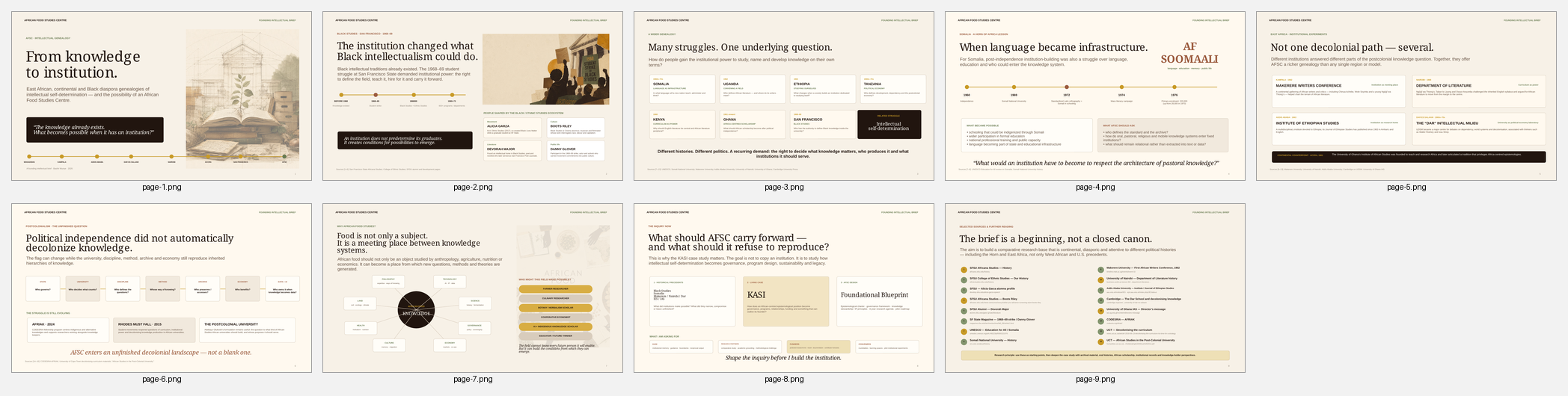
SOMALIA · A HORN OF AFRICA LESSON
For Somalia, post-independence institution-building was also a struggle over language, education and who could enter the knowledge system.
What would an institution have to become to respect the architecture of pastoral knowledge?
A HISTORICAL PRECEDENT
Black intellectual traditions existed long before universities recognized Black Studies. What changed at San Francisco State in 1968 was not the existence of knowledge, but the struggle for institutional space to name it, teach it and build from it.
Black history, political thought, scholarship and community knowledge lived far beyond what universities were willing to recognize.
The Black Student Union and Third World Liberation Front led a 115-day strike at San Francisco State.
The first Black Studies department was established, followed by the first College of Ethnic Studies in 1969.
San Francisco State records that more than 600 Black Studies programs and departments were created in the years that followed.
Black knowledge could organize a field rather than remain an occasional subject inside somebody else's curriculum.
Departments and courses created places to teach Black history, culture, politics and intellectual traditions on sustained terms.
A field could train scholars, develop methods, publish research and carry questions across generations.
Ethnic Studies travelled beyond one campus. Later San Francisco research found positive effects on attendance, graduation and college enrollment for students assigned to an Ethnic Studies course.
POSTCOLONIALISM · THE UNFINISHED QUESTION
The flag can change while the university, discipline, method, archive and economy still reproduce inherited hierarchies of knowledge. AFSC enters that unfinished landscape — not a blank one.
Makerere, Nairobi, Addis Ababa, Dar es Salaam and other African institutions experimented differently. The lesson for AFSC is not to copy a historical formula, but to understand the choices, contradictions and institutional conditions that shaped each one.
TURNING THE MIRROR TOWARD AFSC
African food knowledge already lives in farms, kitchens, markets, pastoral systems, healing practices, seed traditions, trade and community memory.
Anthropology studies one part. Agriculture another. Economics, nutrition, botany and development each hold another. AFSC asks what becomes possible when African food knowledge can organize questions across those disciplines on its own terms.
African food knowledge can be treated as a source of concepts and methods, not only an object to document.
Courses, teaching resources, fellowships and eventually formal pathways in African Food Studies could emerge.
Research could strengthen community ownership, cooperative economies, policy and Pan-African food sovereignty.
Botany, herbalism, biodiversity, agriculture and health can meet through questions rooted in African food systems.
AFSC can ask who consents, who owns, who benefits, what should remain protected and what AI systems should not simply absorb.
Not only cuisine, commodity or heritage - but a body of knowledge with something to contribute to climate, economy, health, technology and the future.
What did institutionalization make possible - and what did it risk?
How does an African-centred epistemology become governance, programming, community and sustainability today?
What should I carry forward, refuse, protect and test before deciding what kind of institution AFSC should become?
KASI · LIVING INSTITUTIONAL CASE
KASI offers AFSC a living case in African-centred institution building.
As I develop AFSC, I am studying how an African-centred epistemological position becomes a living institution — how ideas become governance, programs, relationships, economic models, knowledge-stewardship practices and something capable of outliving its founder.
My relationship with KASI began through an exchange of knowledge. I spent time at KASI, contributed as a keynote speaker, and hosted a Nomadic Supper. Those experiences opened a deeper conversation about institution-building and what an East African expression of this work could become.
I am now developing a case study with KASI as a learning partner — not to reproduce its model, but to learn from its journey: what has worked, what has been difficult, what should remain protected, what can travel, and what another generation of African-centred institution builders might carry forward.
How does an epistemological position become rules, decision-making and accountability?
How does an idea become a lived educational and community practice?
What economic model lets an institution endure without surrendering its purpose?
What should travel, what should remain protected, and who decides?
How does an institution become capable of outliving its founder?
THE RESEARCH AGENDA
I do not expect AFSC - or me personally - to hold every expertise. I am building it to convene disciplines around food and to create research questions that are difficult to ask from inside a single academic silo.
African epistemologies, anthropology, oral traditions, migration, cultural nutrients, culinary knowledge and questions of who is recognized as an expert.
Botany, biodiversity, herbalism, ecological knowledge, food as health, seed knowledge and relationships between food systems and landscapes.
Pan-African food sovereignty, democratic economy, microeconomics, cooperative models, markets, ownership, policy and community control of food systems.
What happens when Indigenous and community knowledge enters databases, AI systems and commercial technologies - including consent, authorship, extraction, attribution and ownership.
What African food knowledge can become: new food-system models, education, institutional design, culinary experimentation and alternative futures.
HOW AFSC WILL WORK
I want AFSC to produce knowledge in more than one setting. A farm, a kitchen, a classroom, an archive and an academic institution can each reveal something the others cannot.
Research with farmers, cooks, elders, growers, producers, herbal practitioners and communities.
Case studies, interdisciplinary research partnerships, publications, fellowships and academic dialogue.
Dinners, ingredients and culinary experiments used as methods for thinking and gathering knowledge.
New approaches to African food studies, culinary education and interdisciplinary learning.
Documenting knowledge while confronting questions of consent, access, authorship, ownership and return.
Technology, AI, ecology, climate and future food systems explored through African intellectual traditions.
CURRENT & EMERGING INQUIRIES
I want AFSC's structure to emerge from real research, relationships and case studies - not from designing an institution in the abstract.
I am studying the Black Studies precedent alongside a KASI-centred institutional case study: how knowledge becomes a field, how a field becomes an institution, and how governance, funding and legitimacy change what that knowledge can do.
What should AFSC carry forward - and what must it protect or refuse?My cassava research asks how farmers and communities understand physical, economic, ecological, social and cultural loss - and how research can strengthen agency rather than extract knowledge.
Who gets to define value, loss and gain?I want AFSC to investigate how AI and digital systems interact with Indigenous and community intellectual property, including consent, attribution, commercialization and the right to keep some knowledge outside the machine.
What should never become training data simply because it can?I am not presenting AFSC as a finished institution. I am making the ambition, research agenda and institutional questions visible while I build the governance, partnerships, funding model and scholarly community needed to sustain it.
Partner in the inquiry →AFSC FOUNDATIONAL STUDY
I am developing AFSC through a foundational research and design phase. A case study developed with KASI as a learning partner, alongside comparative institutional learning, will help me investigate how an African-centred food studies institution can be built, governed and sustained without reproducing extractive structures.
I am not asking partners to validate a structure that has already been decided. I am inviting people to contribute knowledge, experience and resources to the inquiry that will shape what AFSC becomes.
For scholars, practitioners, knowledge holders and communities interested in contributing to the foundational research and analysis.
For institutions willing to share governance lessons, methods, documents and institutional experience as part of the comparative inquiry.
For funders and partners providing resources for research time, travel, interviews, documentation, convening, co-design and the AFSC Foundational Blueprint.
THE INQUIRY IS OPEN